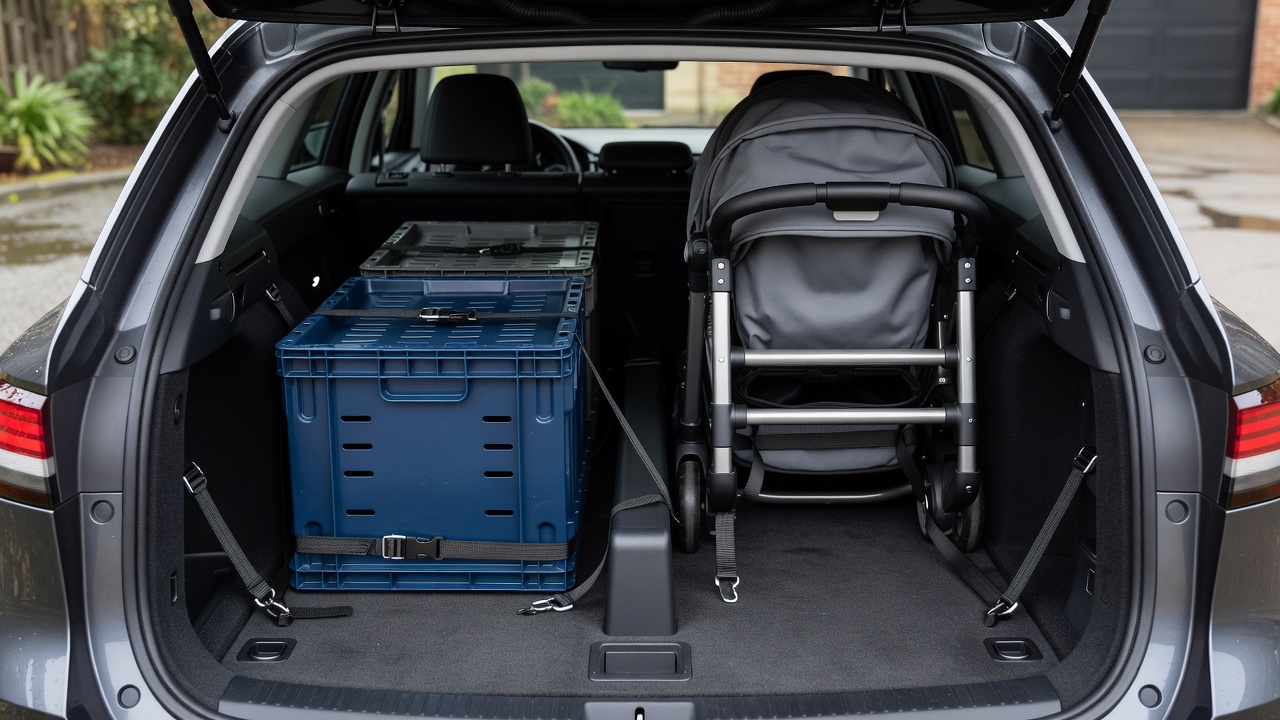
Empty it before you organise it
Take everything out of the boot, including the items that have quietly become permanent passengers. Group the contents by purpose: vehicle equipment, daily errands, family needs, work gear and occasional travel. Return only what earns a place. A storage system cannot compensate indefinitely for carrying equipment you never use.
Find the spare wheel or repair kit, towing eye, warning equipment and any other vehicle-specific essentials. Check how their covers open. If retrieving a tyre inflator means removing a fixed drawer system and half the holiday luggage, the layout has failed an important practical test before the journey begins.
Measure the usable shape
Measure the floor length, narrowest width between the wheel arches and the hatch opening. Note the load lip, sloping rear glass, seatback angle and any protruding hinges. The box that fits inside may still be too wide to pass through the opening. A cardboard template is a simple way to test a proposed container without buying it.
Check whether the boot has an adjustable or removable floor and read its load restrictions. A raised floor panel may have a different capacity from the structural floor beneath it. Do not assume that a flat surface is an approved support for heavy equipment, and do not cover ventilation grilles, battery access or required service points.
Build around three working zones
The first zone is for stable, secured equipment that will remain in place throughout the drive. Dense items should generally be low and positioned to limit movement, using the vehicle’s approved restraint arrangements. The second zone holds things needed at the next stop. The third is flexible space for changing loads, such as shopping, a wet coat or a pushchair.
- Base: stable and restrainedPosition suitable heavy items low, respecting floor and anchorage limits.
- Middle: grouped by taskKeep meal kit, clothing and activity equipment in separate manageable modules.
- Access edge: next-stop itemsMake frequently needed items reachable, but secure them before driving.
These zones describe access priorities, not permission to stack above the seatbacks. Keep sightlines and vehicle safety systems clear. When the load cannot be restrained with the vehicle’s available arrangements, change the load or seek a properly specified solution rather than improvising attachment points.
Choose the container for the job
A folding fabric organiser is useful for light groceries, cleaning supplies or loose clothing. It collapses when not needed and is easy to move between cars. However, thin dividers and carry handles are not necessarily restraint features. Hook-and-loop strips can reduce everyday sliding on compatible carpet, but should not be treated as crash protection.
Rigid containers protect contents from crushing and can make wet or dirty equipment easier to isolate. Look for a manageable loaded weight, comfortable handles and a lid that can be opened in the available space. Check the manufacturer’s stacking guidance. A stackable shape does not mean the stack can travel unsecured.
Drawer systems offer repeatable access for regular users, especially when particular tools or activity equipment are carried every week. Their drawbacks are mass, cost, reduced vertical space and installation requirements. A properly designed drawer installation needs suitable mounting, reliable travel latches and a check against the vehicle’s payload and floor limits.
Make dirty and wet loads easy to remove
Use a removable washable tray or suitable container for muddy footwear and damp equipment. Protect clean luggage from moisture transfer, but do not leave wet textiles sealed for longer than necessary. Take them out to dry after the journey. A waterproof container can keep water in just as effectively as it keeps water out.
For food, use containers suitable for the purpose and follow food-safety guidance on cooling and storage. Keep cleaning chemicals separate and upright in their original labelled packaging. Fuel, gas cylinders and other hazardous items require their own transport precautions; an ordinary boot organiser is not a safety solution for them.
Design for the person doing the lifting
A single large crate may look efficient but become awkward when full. Smaller modules can be easier to carry, reposition and take directly into accommodation. Test the lift over the boot lip and consider whether the person unloading can reach the handles without twisting. Do not fill a container simply because more volume remains.
Label modules by task rather than by a vague category such as “miscellaneous”. “First night”, “walking kit” and “breakfast” are useful because they describe when a container comes out. Put a simple contents list inside any kit that stays packed so missing items are noticed before departure.
Run a stopover rehearsal
Pack the car on the driveway, close the hatch gently and simulate your first stop. Can you get waterproofs without unloading the secured base? Can a passenger reach essential personal items safely when parked? Can you open the spare-wheel compartment? Change the plan now, while the missing space is still a small inconvenience rather than a roadside problem.