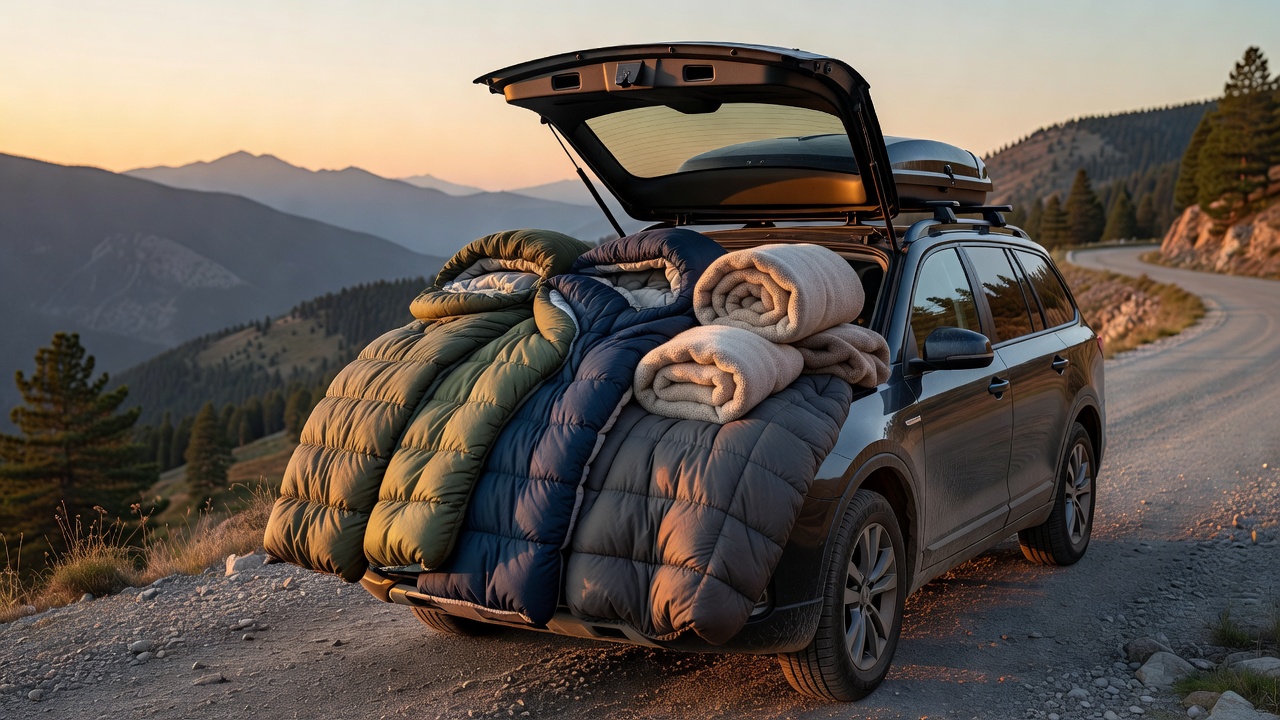
Start with the load, not the litre figure
Put the proposed roof-box contents on the floor first. Bedding, sleeping mats and clothing often make better candidates than dense food containers or heavy tools. Measure the longest item and the widest packed bag. A box with generous advertised volume may still have a narrow nose, shallow lid or fixing hardware that interrupts the space you need.
Make two lists: what can stay upstairs until your destination, and what must be reached during the journey. Rainwear, medication and essential roadside equipment usually belong somewhere easier to access. If your roof box holds the lunch bag, you have introduced an unnecessary climb at every service-area stop.
Compatibility is a complete chain
Identify the vehicle’s exact model, body style, production year and roof type. Raised rails, flush rails, fixed mounting points and a plain roof need different fittings. A panoramic glass roof can bring additional restrictions. Use the vehicle handbook and the rack manufacturer’s current fit guide; visual similarity to another car is not enough.
The box must also fit the crossbars. Check approved bar profiles, clamp opening, bar spacing and any restrictions on channel adapters. Thule and Yakima publish model-specific fitting information, but a brand name alone does not confirm compatibility. Follow the instructions for the exact feet, fitting kit, bars and box you intend to combine.
Work through the weight limit
The vehicle’s permitted roof load normally includes the rack and box as well as their contents. Check the exact wording in the handbook. Each part of the system may impose its own limit, and none may be exceeded. A limit quoted for stationary roof use is not a substitute for the permitted load while driving.
For an illustrative calculation only, a vehicle allowing 75 kg on its roof, fitted with 5 kg of bars and an 18 kg box, leaves 52 kg within that vehicle roof allowance. A lower component limit could reduce the permitted contents further. Occupants and all equipment also count toward the vehicle’s overall mass limits; roof capacity does not create extra payload.
Compare systems through real use
| System | Useful for | Check carefully |
|---|---|---|
| Rigid roof box | Bulky luggage and enclosed touring storage | Internal dimensions, locks, hinge clearance, weight and bar compatibility |
| Roof basket | Suitable weather-resistant equipment with a defined restraint plan | Approved tie-down method, exposed loads and increased overall height |
| Soft roof bag | Occasional use where explicitly approved for the vehicle and mounting arrangement | Attachment instructions, roof protection, weather resistance and load movement |
| Dedicated carrier | A specific item such as a bicycle or kayak | Item compatibility, approved orientation and the complete system’s limits |
Try the access before committing
Open the vehicle’s tailgate fully with the proposed box position checked against the manufacturer’s mounting instructions. Confirm that the hatch, spoiler and aerial will not collide with the box. Check whether the box opens on the side you can safely reach when parked. Dual-side opening can be convenient, but it does not remove the need for a stable loading position.
Measure the vehicle’s actual overall height after fitting the system. Record it somewhere the driver can see when approaching barriers, ferries, covered parking or a garage. Remember that the driver still needs to assess individual restrictions and clearance; a written note is a reminder, not permission to enter.
Pack it as equipment, not an attic
Distribute the contents as the box instructions specify and use its internal restraint system. Keep straps clear of hinges and locking mechanisms. The lid should close without force, and every locking point should engage. A locked lid is not a substitute for securing the contents.
Check fittings at the intervals required by the manufacturer and inspect after circumstances that may loosen the system. Follow the most restrictive applicable speed guidance and adapt to wind, weather and road conditions. Remove the system when it is not needed if practical; it adds weight, height and aerodynamic drag even when empty.
Leave room for the roof box at home
Before buying, decide where the box will live between journeys and how you will lift it without injury or damage. Check your garage dimensions and any approved storage arrangements. Renting a compatible box can make sense for occasional trips, provided fitting, condition and instructions are all verified. The best choice solves the whole ownership problem, not merely the outbound drive.